
Finding your bra size starts with two measurements: your underbust and your full bust.
Our Bra Size Calculator uses those measurements to estimate your starting bra size and shows equivalent sizes across several international sizing systems.
Use your result as a starting point, not an absolute answer. Bra fit also depends on breast shape, band stretch, cup construction, brand sizing, and the style of bra you choose.
Bra Size Calculator
Enter your bust and underbust measurements to estimate your bra size across different international sizing systems.
Measure loosely around the fullest part of your bust.
Measure firmly around your ribcage directly underneath your breasts.
| Location | Band / Size | Cup |
|---|---|---|
| US/CA | — | — |
| UK | — | — |
| US/CA (Underbust +4)* | — | — |
| UK (Underbust +4)* | — | — |
| EU (EN 13402) | — | — |
| FR/BE/ES | — | — |
| Australia/New Zealand | — | — |
*The Underbust +4 / +5 method is an older sizing method still used by some brands.
Bra sizing varies between manufacturers and styles. Use the result as a starting point and adjust according to fit.
How to Measure
Wrap the tape around the fullest part of your breasts. Keep it level and relaxed.
Wrap the tape directly underneath your breasts. Keep it firm and level around your body.
Click Calculate Bra Size to see your estimated size across all supported sizing systems.
Bra Size Converter
Already know your bra size? Select your current sizing system, band and cup to see the equivalent international sizes.
| Location | Equivalent Bra Size |
|---|---|
| US/CA | — |
| UK | — |
| EU (EN 13402) | — |
| FR/BE/ES | — |
| Australia/New Zealand | — |
How to Measure Your Bra Size Correctly
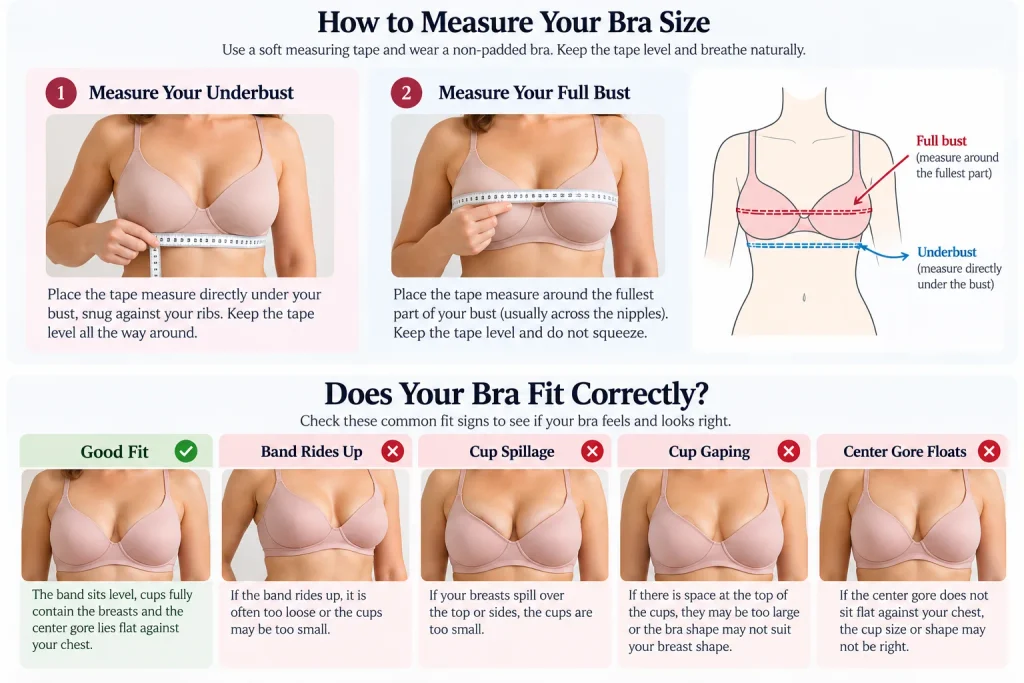
Accurate measurements give you a more useful result.
Use a soft measuring tape, stand naturally, and keep the tape level around your body.
For the best result, wear a non-padded bra or measure without a bra if that feels comfortable.
Measure Your Underbust
Wrap the measuring tape directly under your breasts, around your ribcage.
Keep the tape:
- level around your back
- snug but not painfully tight
- parallel to the floor
Enter this measurement as your underbust.
Your underbust measurement helps estimate your band size.
Measure Your Full Bust
Wrap the tape around the fullest part of your breasts.
Keep the tape level and make sure it rests against your body without compressing the breast tissue.
Enter this number as your bust measurement.
The difference between your bust and band measurements helps estimate your cup size.
How Bra Size Is Calculated
A bra size has two parts:
Band size + cup size
For example:
34D
The number, 34, represents the band.
The letter, D, represents the cup.
The cup letter is based on the difference between your bust measurement and your band measurement.
This is why cup size is relative to band size.
A 34D and a 38D do not have the same cup volume.
That is also why a calculator result can sometimes show a larger cup letter than you expect.
Why Does My Cup Size Look Bigger Than Expected?
This is one of the most common questions after using a bra calculator.
You may currently wear something like:
36B
but calculate closer to:
32D or 32DD
That does not automatically mean your breasts suddenly become “much larger.”
Cup letters only make sense together with the band size.
As the band gets smaller, the cup letter often increases to hold a similar amount of breast tissue.
So try not to judge the result by the cup letter alone.
Always consider the full bra size.
How to Check Whether Your Bra Actually Fits
The calculator gives you a starting size. The bra itself tells you whether that starting point works.
Check these areas when you try on a bra.
The Band
The band provides most of the bra’s support.
A well-fitting band:
- stays level around your body
- does not ride up your back
- feels secure on the loosest hook when the bra is new
- does not feel painfully tight
If the band rides up, it may be too loose.
If it feels extremely tight, the band may be too small, although cups that are too small can also make the whole bra feel tighter.
The Cups
Your breasts should sit fully inside the cups without obvious spilling or large empty spaces.
If you spill over the cup
The cup may be too small or the bra shape may not suit your breast shape.
If the cup gaps
The cup may be too large, but gaping can also happen when the bra shape does not match your breast shape.
This is important because a cup can gap even when the size itself is close.
The Center Gore
The center gore is the fabric between the cups.
In many underwired bra styles, it sits close to the breastbone.
If it floats far away from your body, the cups may be too small, too shallow, or simply the wrong shape for you.
Some bra styles, especially certain plunge bras, naturally have a lower center gore.
The Straps
Straps help position the cups, but they should not provide all of the support.
Your straps should:
- stay on your shoulders
- feel comfortable
- avoid digging deeply into your skin
If you constantly tighten your straps to lift your breasts, check the band fit first.
What If Your Calculated Bra Size Does Not Fit?
This does not necessarily mean the calculator is wrong.
Bra sizing is only part of the fit equation.
The following problems often point you toward your next adjustment.
| Fit Problem | What to Try |
|---|---|
| Band rides up | Try a smaller band |
| Band feels too tight | Try the bra upside down/backwards to test the band alone; if still tight, try a larger band |
| Breast tissue spills over cups | Try a larger cup or a different cup shape |
| Cups visibly gape | Try a smaller cup or a different bra shape |
| Center gore floats away from chest | Try more cup volume or a more projected cup shape |
| Underwire sits on breast tissue | Try a larger cup or wider wire |
| Straps constantly slip | Adjust straps and check whether the band is secure |
| One breast fits differently | Fit the larger breast first and adjust the smaller side if needed |
The most useful rule is:
Change one thing at a time.
That makes it easier to understand whether the problem comes from the band, cup volume, or bra shape.
What Are Sister Sizes
Sister sizes are bra sizes with a similar approximate cup volume but a different band size.
For example, if your current size is:
34D
a nearby sister-size relationship may include:
32DD — smaller band, larger cup letter
36C — larger band, smaller cup letter
You may use a sister size when the cups feel right but the band does not.
If the band feels too loose
Go down one band size and up one cup size.
If the band feels too tight
Go up one band size and down one cup size.
Sister sizing helps with fine adjustments, but it does not replace proper fitting. Moving too many sister sizes away from your measured size can change the proportions of the bra significantly.
US, UK, EU and Australian Bra Sizes Are Different
Bra size labels change between countries.
That means a size such as:
34F
does not always represent the same cup progression in the US and UK systems.
Your calculator provides conversions for:
- US / Canada
- UK
- EU
- France / Belgium / Spain
- Australia / New Zealand
Use those conversions as a guide when shopping internationally.
Always check the size chart provided by the brand, especially once you move beyond common cup letters such as D and DD.
Different brands sometimes use different cup sequences.
What Is the Underbust +4 Method?
You may notice an Underbust +4 result in the calculator.
This comes from an older bra-fitting method that adds approximately four inches to an even underbust measurement, or five inches to an odd measurement, before assigning the band size.
Modern bras use stretchier materials than many older bras, so many current fitters start much closer to the actual underbust measurement instead.
That is why the calculator shows the +4 result separately rather than treating it as the only correct method.
If the two results differ significantly, use the modern result as a starting point and judge the actual bra by how it fits.
Why Bra Size Can Change After 40
Bra size does not stay fixed throughout adult life.
Your measurements and the way your breasts sit can change over time.
You may notice changes in:
- breast volume
- breast position
- firmness
- ribcage measurement
- weight distribution
- body composition
- comfort with certain bra styles
Pregnancy history, weight changes, hormonal changes, perimenopause, menopause, and normal ageing can all influence how a bra fits.
This is why a size that works perfectly for you in your thirties may no longer feel right later.
The answer is not automatically to buy the same size in a “more supportive” style.
Start by measuring again.
You may discover that your band, cup, or both have changed.
Bra Fit After 40: Comfort and Support Matter Together
Many women over 40 start paying more attention to comfort.
That does not mean giving up shape, lift, or a polished look under clothing.
The goal is to find a bra that supports your current body without creating unnecessary pressure.
Depending on your preferences, you may find that you prefer:
- softer underwires
- wider bands
- wider straps
- side-support panels
- unlined seamed cups
- wireless bras
- full-coverage bras
- balconette bras
- plunge bras
The best choice depends on both your size and your breast shape.
Bra Size and Bra Shape Are Not the Same Thing
You can wear the correct size and still dislike the fit.
For example, two bras in 34DD can feel completely different.
One may have:
- shallow molded cups
while another has:
- deeper, seamed cups with more projection
If your breast shape does not match the cup shape, you may see:
- gaping
- spilling
- wrinkling
- wire pressure
- an uncomfortable center gore
This is why changing bra style can sometimes solve a fit problem without changing bra size.
Which Bra Style Should You Try?
Full-Cup Bra
A full-cup bra offers more coverage and can feel secure for everyday wear.
It often works well when you want:
- more coverage
- less upper-cup movement
- a smooth, contained fit
Balconette Bra
A balconette usually has a lower-cut cup with wider-set straps.
It can work well under:
- square necklines
- scoop necks
- wider necklines
Plunge Bra
A plunge bra has a lower center gore.
It works especially well under:
- V-necks
- wrap tops
- lower necklines
Unlined Seamed Bra
An unlined bra uses fabric panels rather than thick molded foam.
Many women find that this construction adapts more naturally to breast shape.
Wireless Bra
A wireless bra removes the underwire and relies more on fabric structure, band design, and cup construction.
A well-designed wireless bra can still provide substantial support.
How Often Should You Measure Your Bra Size?
You do not need to measure yourself every week.
Measure again when:
- your bras suddenly feel uncomfortable
- the band starts riding up
- cups begin spilling or gaping
- your weight changes
- you go through pregnancy or breastfeeding
- your body changes during perimenopause or menopause
- you have not checked your size for a long time
Even without major weight changes, your fit can shift over time.
Common Bra Measurement Mistakes
Avoid these common mistakes when using the calculator:
- measuring over thick clothing
- wearing a heavily padded bra while measuring
- letting the tape slope down your back
- pulling the tape too tightly
- measuring the bust too loosely
- holding your breath
- rounding measurements too aggressively
- mixing centimeters and inches
- assuming your old bra size must still be correct
Measure twice if possible.
If the numbers differ, measure once more and use the value you reproduce most consistently.
Frequently Asked Questions
Is a bra size calculator accurate?
A bra size calculator gives you a useful starting point.
Actual fit also depends on breast shape, bra construction, band stretch, brand sizing, and personal comfort.
Always use the fit of the bra itself to confirm the result.
Should I measure with or without a bra?
A non-padded, well-fitting bra usually works well for taking a bust measurement.
Avoid heavily padded, push-up, or minimizer bras because they can change the measurement.
Why does my calculator result have a larger cup letter than I wear now?
Cup size is relative to band size.
When the band becomes smaller, the cup letter often becomes larger to maintain similar cup volume.
A larger cup letter does not automatically mean dramatically larger breasts.
Why does my band feel tight even when the measurement looks correct?
A band can feel tight because:
- the band is genuinely too small
- the cups are too small
- the cups are too shallow
- the brand runs firm
- the bra is new and has less stretch
Try testing the band separately by putting the bra on upside down and backwards so the cups are not involved.
What if one breast is larger than the other?
Minor breast asymmetry is very common.
Fit the bra to your larger breast first.
You can then adjust the strap on the smaller side or use removable padding if you want a more even appearance.
Should the center of the bra touch my chest?
In many underwired bras, the center gore sits close to the breastbone.
Some low-gore plunge styles fit differently, and individual anatomy also matters.
If the gore consistently floats far away, check cup volume and cup shape.
Does bra size change with age?
It can.
Your ribcage, breast volume, tissue distribution, and breast position can all change over time.
Remeasure when your bras stop fitting the way they normally do.
What is the best bra for women over 40?
There is no single best bra for every woman over 40.
The best bra combines:
- correct sizing
- suitable cup shape
- comfortable support
- a style that works with your wardrobe
- your personal preferences
Your age does not determine one bra style.