
Finding your ring size starts with one simple measurement.
You can use our Ring Size Calculator in either of two ways:
- measure the inside diameter of a ring that already fits
- measure the circumference of the finger where you plan to wear the ring
Enter your measurement above and the calculator estimates your ring size across common systems, including US/Canada, UK/Australia, EU, and Japan.
Ring-size conversions can vary slightly between jewelers, so use your result as a starting point and check the retailer’s own sizing chart before buying an expensive or difficult-to-resize ring.
Ring Size Calculator
Enter your finger circumference or the inside diameter of a ring to estimate your ring size.
Wrap a strip of paper or measuring tape around the base of your finger and measure the length in millimeters.
| Region | Estimated Size |
|---|---|
| US / Canada | — |
| UK / Australia | — |
| EU | — |
| Japan | — |
| Inside Diameter | — |
| Finger Circumference | — |
Ring sizing can vary slightly between jewelers. Wider bands often feel tighter and may require a slightly larger size.
How to Measure Your Ring Size at Home
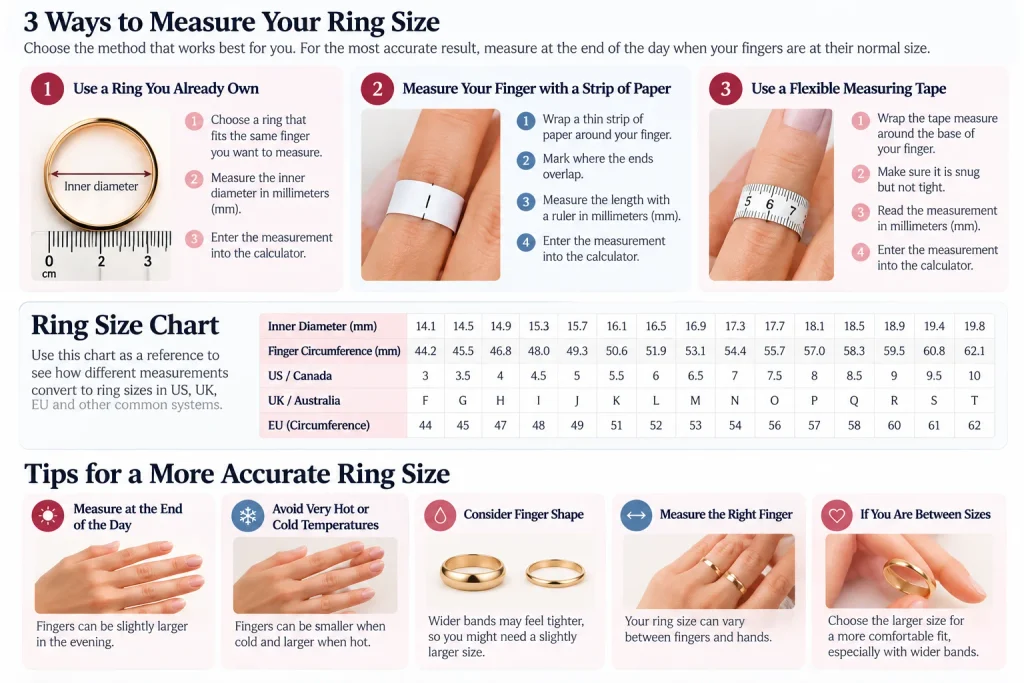
You have two practical ways to measure your ring size.
Method 1: Measure a Ring That Already Fits
If you already own a ring that fits the correct finger comfortably, this is usually the easiest home method.
Place the ring flat on a ruler and measure straight across the inside of the ring, from one inner edge to the opposite inner edge.
Do not include the thickness of the metal.
Measure in millimeters for the most useful result.
For example, Tiffany lists an inside diameter of approximately 17.3 mm as a US size 7, with an inside circumference of about 54.4 mm.
Method 2: Measure Your Finger Circumference
If you do not have a ring that already fits:
- Wrap a flexible measuring tape around the base of your finger.
- Keep it comfortably snug rather than tight.
- Note the measurement in millimeters.
- Enter that number as your finger circumference.
Tiffany also suggests using string when a flexible tape is unavailable, then laying it flat and measuring the marked length.
Which Measurement Method Is More Accurate?
If you already own a ring that fits the correct finger, measuring its inside diameter is usually easier than wrapping paper or string around your finger.
GIA warns that paper and string can introduce inaccuracies because string stretches and paper can bend or change shape. For an important purchase, professional sizing with ring gauges is more reliable.
For everyday fashion rings, either home method can still give you a useful estimate.
What Does Your Ring Size Result Mean?
Different countries use different labels for the same physical ring measurement.
A ring with an inside circumference of about 54.4 mm is approximately:
- US / Canada: 7
- EU: around 54
- UK / Australia: around N–N½ depending on the chart
- Japan: approximately 14
International conversion charts do not always line up perfectly, so use the retailer’s own size chart when possible.
Why Ring Sizes Differ Between Countries
Ring sizing is based on physical measurements, but each sizing system labels those measurements differently.
US and Canada
The US system uses numbers and half sizes, such as:
6, 6.5, 7, 7.5
UK and Australia
The UK and Australian systems commonly use letters, sometimes with half sizes, such as:
M, M½, N, N½, O
Europe
European sizing commonly follows the inside circumference of the ring in millimeters.
Japan
Japan uses its own numerical scale.
This means one physical ring can have several different size labels depending on where you shop.
What If You Are Between Two Ring Sizes?
If your measurement falls between two sizes, choosing the larger size is often more comfortable.
Tiffany specifically recommends choosing the larger size when you fall between two measurements.
Sizing up can also make sense when:
- your fingers swell during the day
- the ring has a wide band
- you plan to stack several rings
- your knuckle is wider than the base of your finger
The ring should still feel secure enough that it does not slide off easily.
How Should a Ring Fit?
A well-fitting ring feels secure without feeling restrictive.
It should:
- slide over your knuckle with gentle resistance
- sit comfortably at the base of your finger
- stay in place during normal movement
- come off without pain
GIA describes a correct ring size as loose enough to pass over the finger joint while still settling properly where the ring is worn.
Why Your Ring Size Changes During the Day
Your finger size is not perfectly constant.
Temperature, activity, and normal swelling can change how a ring feels.
GIA notes that fingers can shrink in colder conditions and swell in warmer conditions, and that time of day, humidity, and altitude can also affect finger size.
For a more reliable measurement:
- measure more than once
- measure when your hands are at a comfortable temperature
- avoid measuring immediately after being very cold
- avoid measuring immediately after intense activity
- compare measurements at different times
Wide Rings Often Feel Tighter
Band width matters.
A wider ring places more metal against your finger than a narrow band, so it can feel tighter even when both rings carry the same nominal size.
GIA recommends different sizing gauges for wider rings and notes that bands wider than about 4 mm need special consideration.
If you are buying:
- a wide statement ring
- a chunky band
- a wide wedding band
- a bridal stack
do not assume a size taken from a thin ring will feel identical.
Ring Stacking Can Change the Fit
Several rings worn together create more total width around your finger.
That can make a stack feel tighter than a single ring.
This matters especially with:
- engagement ring + wedding band
- multiple stacking rings
- anniversary bands
Tiffany specifically advises considering where a ring stack will sit when measuring.
What If Your Knuckle Is Larger Than the Base of Your Finger?
Some people have a noticeably wider knuckle than the part of the finger where the ring sits.
Your ring needs enough room to pass over the knuckle without becoming excessively loose once it reaches the base.
GIA discusses sizing solutions such as small sizing beads for rings that turn because the finger joint is much larger than the area where the ring rests.
A jeweler can help if this happens regularly.
Should You Size Up for a Wide Band?
Sometimes, yes.
A wide band often feels tighter than a narrow ring at the same nominal size.
However, do not automatically add half a size to every wide ring.
The right adjustment depends on:
- band width
- ring profile
- finger shape
- knuckle size
- how much your fingers swell
For an important purchase, try a sizing gauge that is close to the actual width of the ring.
How to Measure for an Engagement Ring
If the ring is for yourself, measure the exact finger and hand where you plan to wear it.
If the ring is a surprise, use an existing ring that already fits that same finger whenever possible.
Tiffany recommends choosing a ring that already fits well and measuring its interior diameter in millimeters.
Professional sizing is especially useful for:
- engagement rings
- wedding rings
- expensive jewelry
- antique rings
- full-eternity bands
- custom-made rings
- designs that are difficult to resize
Does Your Left Hand Have the Same Ring Size as Your Right?
Not always.
The same finger on opposite hands can measure differently.
GIA notes that dominant and non-dominant hands can differ, which is another reason to measure the exact finger where you plan to wear the ring.
Do not assume the ring finger on one hand automatically matches the other.
Can Ring Size Change Over Time?
Yes.
Your ring size can change over time because of changes in:
- body weight
- fluid retention
- joint shape
- swelling
- temperature
- activity
For women over 40, the practical takeaway is simple:
do not rely forever on a ring size you measured years ago.
If older rings start feeling noticeably tighter or looser, measure again before ordering a new ring.
What If a Ring Is Too Loose?
A loose ring may:
- rotate constantly
- slide up and down your finger
- pass over your knuckle too easily
- feel as if it might fall off
Possible solutions include:
- professional resizing
- temporary ring adjusters
- sizing beads
- sizing bars
For valuable jewelry, speak with a jeweler before making permanent changes.
What If a Ring Is Too Tight?
A ring is probably too tight if it:
- causes pain
- feels restrictive
- is very difficult to remove
- repeatedly becomes stuck
- creates numbness or discomfort
A ring should feel secure, but it should still move over the knuckle without pain.
Common Ring-Measuring Mistakes
Avoid these common errors:
- measuring the outside diameter instead of the inside diameter
- including the thickness of the metal
- measuring the wrong finger
- measuring the correct finger on the wrong hand
- pulling paper or tape too tightly
- measuring only once
- measuring when your hands are extremely cold
- ignoring band width
- assuming every retailer uses exactly the same conversion chart
Measure more than once whenever possible.
Frequently Asked Questions
What is the easiest way to find my ring size?
If you already own a ring that fits the correct finger, measure its inside diameter in millimeters.
If you do not have one, measure your finger circumference with a flexible tape.
Is ring diameter the same as circumference?
No.
Diameter measures straight across the inside of the ring.
Circumference measures all the way around the inside.
They are mathematically related.
What does a 17.3 mm ring diameter mean?
Tiffany lists approximately 17.3 mm inside diameter as a US size 7, with a circumference of about 54.4 mm.
What if I am between ring sizes?
Try the larger size first, particularly if the ring is wide or your fingers swell. Tiffany also recommends the larger size when measurements fall between sizes.
Does band width affect ring size?
Yes.
Wide bands can feel tighter than narrow bands, and GIA recommends accounting for band width during sizing. gia
Should a ring be difficult to remove?
You should feel some resistance as the ring passes over your knuckle, but removing it should not normally hurt.
Are US and UK ring sizes exactly convertible?
Not always.
Conversion charts can differ slightly, particularly around half sizes. Treat international conversions as close equivalents and check the retailer’s own chart.
Are men’s and women’s ring sizes different systems?
No.
The same sizing systems apply. The typical size ranges may differ, but the underlying ring-size system remains the same.
Your Ring Size Is a Starting Point
A home measurement helps you get close to the right size.
Your actual fit still depends on:
- band width
- finger shape
- knuckle size
- temperature
- ring design
For everyday fashion rings, a calculator estimate is often enough to start shopping.
For an engagement ring, wedding ring, expensive piece, or a design that is difficult to resize, confirm the fit with the retailer or a professional jeweler before ordering.