
Dress Size Calculator
Enter your bust, waist and hip measurements to estimate your women’s dress size.
Measure around the fullest part of your bust.
Measure around your natural waistline.
Measure around the fullest part of your hips.
| Region | Estimated Size |
|---|---|
| US / Canada | — |
| UK | — |
| EU | — |
| Australia | — |
Clothing sizes are not standardized across brands. Use this estimate as a starting point and always compare your measurements with the retailer’s own size chart.
Dress Size Calculator
Finding your dress size starts with three measurements:
- Bust
- Waist
- Hips
Enter your measurements into the calculator above to estimate your dress size across US/Canada, UK, EU, and Australian sizing systems.
Use the result as a starting point, not a guarantee. Women’s dress sizes are not standardized across brands, so the same measurements can correspond to different labels from one retailer to another. Research on women’s apparel sizing confirms substantial variation between brands and price segments.
How to Measure for Your Dress Size
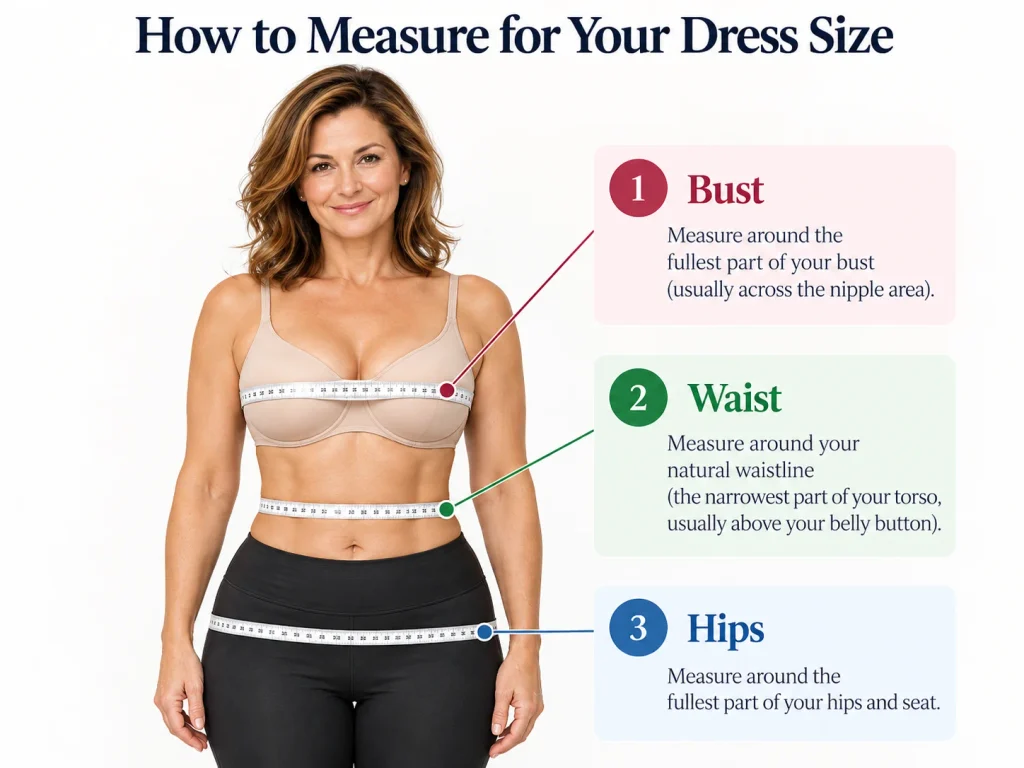
For the most useful result, use a soft measuring tape and measure your body rather than a dress you already own.
Keep the tape level and comfortably close to your body without pulling it tight.
Measure Your Bust
Wrap the tape around the fullest part of your bust.
Keep the tape level across your back and wear a well-fitting bra that does not heavily pad or compress your bust.
Measure Your Waist
Measure around your natural waistline.
This is usually the narrowest part of your torso, above your belly button.
Stand naturally and avoid holding your stomach in.
Measure Your Hips
Measure around the fullest part of your hips and seat.
Keep your feet together and make sure the tape stays level.
These three measurements are the most common inputs used by dress-size calculators and retailer size charts.
How the Dress Size Calculator Works
Your calculator compares your bust, waist, and hip measurements with a general women’s size chart.
The result uses the smallest dress size that accommodates all three measurements.
For example, if:
- your bust fits a US 10
- your waist fits a US 12
- your hips fit a US 12
the calculator recommends approximately US 12.
This approach is practical because a dress needs enough room for the largest relevant measurement.
Several current dress-size tools use the same general principle: size to the measurement that requires the larger garment, then check the actual brand chart.
Why Your Dress Size Can Be Different Between Brands
A size number is not a universal physical measurement.
A US 10 from one retailer can fit differently from a US 10 from another.
Brands make their own decisions about:
- pattern dimensions
- ease
- fit preference
- target customer
- fabric stretch
- grading between sizes
This is one reason two dresses with the same size label can feel completely different.
Academic research examining 54 US apparel retailers finds meaningful variation in women’s sizing and evidence of vanity sizing, where labels become smaller relative to garment measurements.
So if your calculator says US 12, treat that as your starting point and check the specific retailer’s chart before ordering.
What If Your Measurements Fall Into Different Sizes?
This is extremely common.
You may have measurements such as:
- Bust: size 10
- Waist: size 12
- Hips: size 14
That does not mean your measurements are unusual.
It simply means the garment needs to accommodate different proportions.
For most dresses, start with the size that fits your largest measurement, especially if the fabric has little stretch.
You can often tailor a garment that is slightly loose in one area more easily than you can make a garment larger where it is too tight.
Which Measurement Matters Most for a Dress?
It depends on the dress style.
Fitted sheath dress
Bust, waist, and hips all matter because the garment follows the body closely.
A-line dress
Bust and waist usually matter more than hips because the skirt widens below the waist.
Shift dress
Bust and shoulder fit can matter more because the waist is less defined.
Wrap dress
Bust and waist matter strongly, but adjustable wrapping can provide more flexibility.
Stretch dress
You may have more room to choose between two sizes because the fabric adapts to the body.
This is why dress style matters almost as much as the size label.
What If You Are Between Two Dress Sizes?
If your measurements fall between two sizes, consider:
- fabric stretch
- how fitted you want the dress
- which part of your body needs more room
- whether the dress can be altered
Choose the larger size when:
- the fabric has little or no stretch
- the dress is fitted through the bust, waist, or hips
- you want more comfort
- one measurement clearly falls into the larger size
A smaller size may work when:
- the fabric is very stretchy
- the dress has a relaxed cut
- you prefer a closer fit
Retailer-specific guidance still takes priority.
US, UK, EU and Australian Dress Sizes Are Different
International dress sizes use different number systems.
A general conversion often looks like this:
US 8 → UK 12 → EU 38 → AU 12
But these conversions are approximate rather than universal.
Current dress-size tools commonly display crosswalks between US, UK, EU, and Australian labels while warning users that brands grade their own patterns differently.
Your calculator gives you:
- US / Canada
- UK
- EU
- Australia
Use those values to understand the likely equivalent label, then confirm with the brand’s own chart.
Why Is My EU Size So Much Higher Than My US Size?
The numbers come from different sizing systems.
For example:
US 10 may convert approximately to:
- UK 14
- EU 40
- AU 14
The larger EU number does not mean the garment is physically larger.
It is simply a different labeling system.
Dress Size vs Body Shape
Dress size and body shape answer different questions.
Dress size tells you:
Which garment size may accommodate your measurements.
Body shape tells you:
How your bust, waist, and hips compare with one another.
Two women can both wear a US 12 while having very different body proportions.
Likewise, two women with similar body shapes can wear completely different dress sizes.
If you want to understand your proportions rather than your clothing size, use our Body Shape Calculator.
Why a Dress in the “Right Size” Can Still Fit Poorly
The label may be correct while the cut is wrong for your proportions.
For example:
A dress may fit your bust perfectly but pull across your hips.
Another dress may fit your hips but leave too much room around your waist.
This often happens because ready-to-wear garments are designed around a specific set of proportional assumptions.
Research on apparel fit shows that body-shape differences can create significant mismatches with standard sizing systems.
That is why fit problems do not automatically mean you need a different overall size.
Sometimes you need:
- a different cut
- a different brand
- a petite or tall version
- a curvy fit
- tailoring
Common Dress Fit Problems and What They Often Mean
| Fit Problem | What It May Suggest |
|---|---|
| Pulling across bust | More bust room or a larger size |
| Waist feels loose | Your waist is smaller relative to bust/hips |
| Tight across hips | More hip room or a different silhouette |
| Shoulder seams sit too low | Garment may be too large through upper body |
| Dress rides up | Tightness through hips or torso |
| Waist seam sits too high | You may need a longer torso or tall sizing |
| Waist seam sits too low | Petite sizing may fit better |
| Fabric wrinkles horizontally | Area may be too tight |
| Fabric hangs with excess folds | Area may be too loose |
Petite, Regular and Tall Dress Sizes
Dress size is not only about circumference.
Height and vertical proportions matter too.
A woman can have the correct bust, waist, and hip size but still find that:
- the waist seam sits too low
- the hem falls incorrectly
- straps feel too long
- sleeves are too long
- darts sit in the wrong place
This is where petite, regular, and tall sizing become useful.
Petite sizing usually adjusts vertical proportions rather than simply making the garment narrower.
Tall sizing does the opposite by adding length through areas such as the torso, sleeves, or skirt.
Always check the retailer’s height guidance because brands define petite and tall differently.
Does Fabric Stretch Affect Dress Size?
Yes.
Stretch changes how much a garment can accommodate.
Woven fabric
Materials such as:
- cotton poplin
- linen
- satin without stretch
- structured suiting
usually require more precise sizing.
Stretch fabric
Materials containing elastane or spandex can provide more flexibility through the bust, waist, and hips.
This means two dresses with identical labeled measurements can feel very different depending on the fabric.
Do not rely on the size number alone.
Check:
- fabric composition
- product description
- fit notes
- customer reviews
Why Dress Size Can Change After 40
Your dress size can change over time, but the more important change is often where your measurements change.
You may notice differences in:
- waist circumference
- bust measurement
- hip measurement
- abdominal shape
- posture
- muscle distribution
- torso proportions
Research on mature women’s apparel fit notes that traditional ready-to-wear systems often fail to fully account for proportional changes associated with ageing.
For women over 40, this means an old size label may no longer predict fit as well as your current measurements do.
If dresses that once worked for you start fitting differently, measure again rather than assuming you still need the same size.
Your Size Label Does Not Define Your Body
Dress-size labels are inconsistent.
One brand may call a garment a size 10 while another uses size 12 for very similar measurements.
Research into vanity sizing shows that women’s size labels differ substantially across retailers.
So the number inside your dress is not an objective measurement of your body.
The useful information is:
- how the garment fits
- whether you feel comfortable
- whether the proportions work for you
Should You Size Up or Size Down?
Use the dress construction as your guide.
Consider sizing up when:
- the dress has no stretch
- your bust or hips fall into the larger size
- you are between sizes
- the style is very fitted
- you prefer more ease
Consider sizing down when:
- the dress runs large
- the fabric has substantial stretch
- the cut is oversized
- the retailer specifically recommends it
Do not automatically size down because you prefer the smaller number.
Fit matters more than the label.
When Tailoring Makes More Sense Than Changing Size
Sometimes neither neighboring size fits perfectly.
For example:
Size 10 fits your waist but pulls at your hips.
Size 12 fits your hips but feels loose at the waist.
In this case, buying the size that accommodates your hips and tailoring the waist may produce a better result than forcing the smaller size.
Simple alterations may include:
- taking in the waist
- shortening the hem
- adjusting straps
- reducing excess fabric at the sides
More complex alterations involving shoulders, bust construction, or heavily embellished areas may cost more.
Common Dress Measurement Mistakes
Avoid these errors when using the calculator:
- measuring over bulky clothing
- pulling the tape too tightly
- measuring your waistband instead of natural waist
- sucking in your stomach
- measuring hips too high
- letting the tape slope
- wearing a heavily padded bra during bust measurement
- mixing inches and centimeters
- using measurements from several years ago
Measure each area twice if possible.
If the readings differ significantly, measure again.
Frequently Asked Questions
What measurements do I need for a dress size calculator?
You need your:
- bust
- waist
- hips
These are the measurements most commonly used to estimate women’s dress size.
What if my bust, waist, and hips are three different sizes?
Choose the size that accommodates your largest measurement, especially for fitted or non-stretch dresses.
Then use tailoring or a different silhouette if another area feels loose.
Is US size 10 the same as UK size 10?
No.
A US 10 commonly corresponds approximately to a UK 14, although brand charts vary.
Is EU sizing the same everywhere?
No.
EU conversions are useful references, but individual European brands can still use different measurements and cuts.
Should I use my old dress size?
Use your current measurements instead.
Your size can change over time, and brands also change their sizing.
Why do I wear different sizes in different brands?
Women’s clothing sizes are not universally standardized.
Each brand develops its own size chart, grading, fit model, and ease. Research documents substantial variation between women’s apparel brands.
Is it better to size up when between sizes?
Often yes for fitted, structured, or non-stretch dresses.
Stretchy or oversized styles may allow more flexibility.
Does body shape affect dress size?
Body shape does not directly determine your size, but it affects how a particular cut fits your proportions.
Two women in the same size can experience very different fit through the bust, waist, and hips.
Can dress size change after 40?
Yes.
Changes in bust, waist, hips, body composition, and overall proportions can affect which size fits best.
Use current measurements rather than relying on the size you wore years ago.
Your Dress Size Is a Starting Point
A dress-size calculator helps you narrow down where to start.
It does not replace the retailer’s own chart or the actual fit of the garment.
Use your result to identify your likely size, then consider:
- your largest measurement
- dress silhouette
- fabric stretch
- petite or tall proportions
- brand-specific sizing
The goal is not to fit yourself into a number.
The goal is to find the size and cut that fit you comfortably.